The 1863 flour barrel that still lets an accident speak for itself.
A barrel fell from a Liverpool flour dealer's loft and nobody saw why. The court let the accident itself stand as evidence of negligence, and U.S. courts still use that rule, res ipsa loquitur, to decide which cases reach a jury.
By Simone Beaumont, Senior Editor
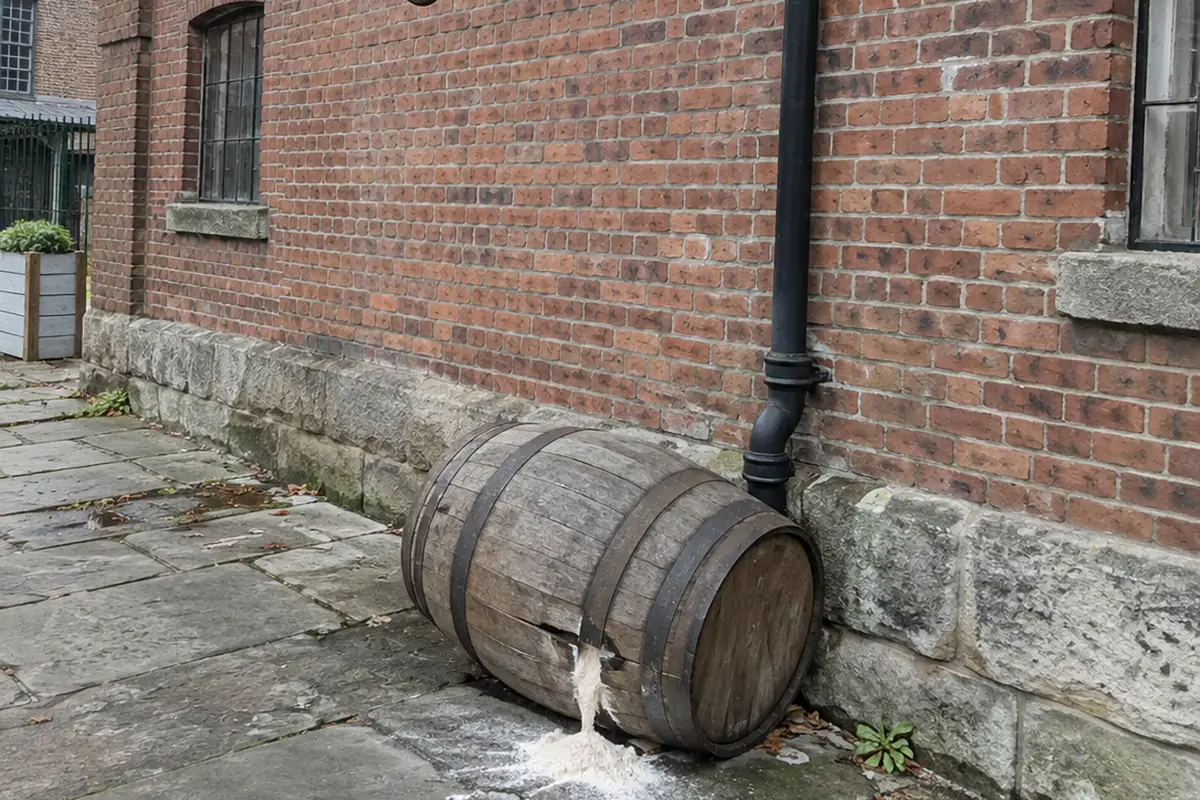
The barrel fell on Scotland Road
Byrne was walking along Scotland Road in Liverpool when a barrel of flour fell from an upper-floor opening of Boadle's premises and struck him. Boadle was a flour dealer. Witnesses saw Byrne being struck, but no witness could say how the barrel came to fall.
The case was tried in the Court of Passage at Liverpool before an assessor. Byrne was nonsuited because he had no direct evidence showing how the barrel fell. The liability claim did not go forward.
Byrne v. Boadle, 2 Hurlstone & Coltman 722, 159 Eng. Rep. 299, reached the Court of Exchequer on review and was decided on November 25, 1863. The court held that the fall itself was sufficient prima facie evidence of negligence to go to the jury. It also held that the accident placed on Boadle the burden of showing that the fall was not caused by his negligence. The nonsuit was set aside in Byrne's favor.
Chief Baron Pollock said, "There are certain cases of which it may be said res ipsa loquitur." The Latin phrase means the thing speaks for itself.
Pollock reasoned that people who keep barrels in a warehouse have a duty to prevent them from rolling out. A barrel could not roll from a warehouse without some negligence. Requiring an injured passer-by to bring forward witnesses from inside the warehouse would be "preposterous."
Byrne supplied a method of proof, not a new claim
The rule in Byrne addressed a proof problem. Byrne could show the injury and the barrel's source. He could not show what happened inside the premises before the barrel struck him. The court treated the accident itself as evidence from which negligence could be inferred.
That remains the function of res ipsa loquitur. It is not a separate cause of action. It can get a negligence claim past a nonsuit or directed verdict when the plaintiff has no eyewitness to the mechanism of injury. It does not decide the case.
Traditional U.S. formulations state three elements. The event must be of a kind that ordinarily does not happen without negligence. The instrumentality must have been within the defendant's control. The plaintiff must not have caused or contributed to the event.
Modern courts discuss the doctrine in settings that include objects falling from buildings, surgical injuries to unconscious patients, and elevator or escalator incidents. The central issue is still whether the facts support an inference that the defendant's carelessness, rather than some other cause, produced the injury.
The Restatement (Third) of Torts: Liability for Physical and Emotional Harm, section 17 (American Law Institute, 2010), states the rule in different terms. A factfinder may infer negligence when the accident is the type that ordinarily results from the negligence of a class of actors of which the defendant is the relevant member. That formulation replaces rigid exclusive-control language with a class-of-actors approach.
American courts developed the rule on a separate track
The Archivar editorial desk read the 1863 report alongside the 1913 Sweeney opinion and the text of California Evidence Code section 646. The desk noticed that Sweeney, the U.S. Supreme Court's leading statement of the doctrine, never cites Byrne v. Boadle and instead relies on American precedents. The English origin and the American rule developed on separate tracks.
In Sweeney v. Erving, 228 U.S. 233, decided April 7, 1913, a patient suffered an X-ray burn after diagnostic X-ray exposures by the defendant physician. Justice Pitney's opinion explained that res ipsa loquitur means the facts warrant an inference of negligence, not that they compel one.
Sweeney also rejected treating the doctrine as a shift in the burden of proof. After all the evidence is presented, the jury decides whether the preponderance favors the plaintiff.
That approach treats res ipsa loquitur as a permissible inference. The plaintiff uses the surrounding facts to ask the jury to infer negligence, but the plaintiff retains the burden of persuasion.
California makes the procedural choice explicit
Jurisdictions split over the doctrine's procedural effect. Most follow the permissible-inference approach described in Sweeney. California illustrates the other approach.
California Evidence Code section 646, added by Stats. 1970, ch. 69, makes res ipsa loquitur "a presumption affecting the burden of producing evidence." Under section 646(c), once the defendant introduces evidence that would support a finding of no negligence or no proximate cause, the court may, and on request shall, instruct the jury that it may still draw the inference of negligence from the underlying facts. The jury may find negligence only if it concludes, after weighing all the evidence, that negligence was more probable than not.
California's civil jury instructions carry that rule into medical cases through CACI No. 518. The distinction changes the instructions the jury receives, even though the evidence and the underlying accident may be the same.
California also extended the control element beyond a single defendant in Ybarra v. Spangard, 25 Cal.2d 486, decided December 27, 1944. The patient entered an appendectomy with no shoulder problem and woke with an injury to his shoulder and arm. The California Supreme Court held that defendants who had control over the patient's body or over the instrumentalities that might have caused the injury could be called upon to explain their conduct. The decision applied the control concept to a group of defendants.
The first call can preserve the missing facts
A defense response to a res ipsa claim is evidence of care or an alternative cause. The initial record should therefore separate what the witness saw from what the witness inferred. In a case involving a falling object, an unconscious patient, or an elevator incident, the distinction may bear directly on control and on whether the plaintiff's own conduct caused or contributed to the injury.
Archivar, which publishes The Docket, is an operating system for law firms that answers every call 24/7 in English and Spanish, runs intake, manages matters and remembers everything the firm does. In a res ipsa case, the first call often comes from someone who saw the injury but not its cause, so what the caller did and did not see, recorded at intake, is the starting record for the control and plaintiff's own conduct elements.
The 1863 rule decides a narrower question now: whether the accident itself supports taking negligence to the jury. The plaintiff still carries the burden, but when the event points to carelessness and the defendant held the thing that caused it, a lack of eyewitnesses no longer ends the case.
A barrel does not leave a warehouse window on its own.
That inference got Byrne past a nonsuit in 1863, and it still gets plaintiffs to a jury.
Whether it is an inference or a presumption depends on where the case is filed.
The 1863 holding
A fall that ordinarily means carelessness is enough prima facie evidence of negligence to go to the jury, with no eyewitness to the cause.
Three traditional elements
The kind of event that needs negligence, an instrumentality in the defendant's control, and no contribution by the plaintiff.
Inference or presumption
Sweeney v. Erving (1913) treats it as an inference. California Evidence Code section 646 makes it a presumption affecting the burden of producing evidence.
What it decides now
Whether a negligence claim survives a nonsuit or directed verdict. The plaintiff still carries the burden of persuasion.
Archivar
The Archivar Editorial Desk
Every case citation, date, holding and quotation above was checked against the reported decisions and the statutory text, with each point confirmed in at least two independent sources. The procedural effect of res ipsa loquitur varies by jurisdiction, so confirm the current law where a case is pending before relying on anything here. This article is for general informational purposes and is not legal advice.
Sources: Byrne v. Boadle, 2 Hurl. & C. 722, 159 Eng. Rep. 299 (Ex. 1863); Sweeney v. Erving, 228 U.S. 233 (1913); California Evidence Code section 646; Judicial Council of California Civil Jury Instructions, CACI No. 518; Ybarra v. Spangard, 25 Cal.2d 486 (1944); American Law Institute, Restatement (Third) of Torts: Liability for Physical and Emotional Harm, section 17 (2010); University of Minnesota Law Library, Classic Cases in Tort Law: Byrne v. Boadle.